For Successor Physicians
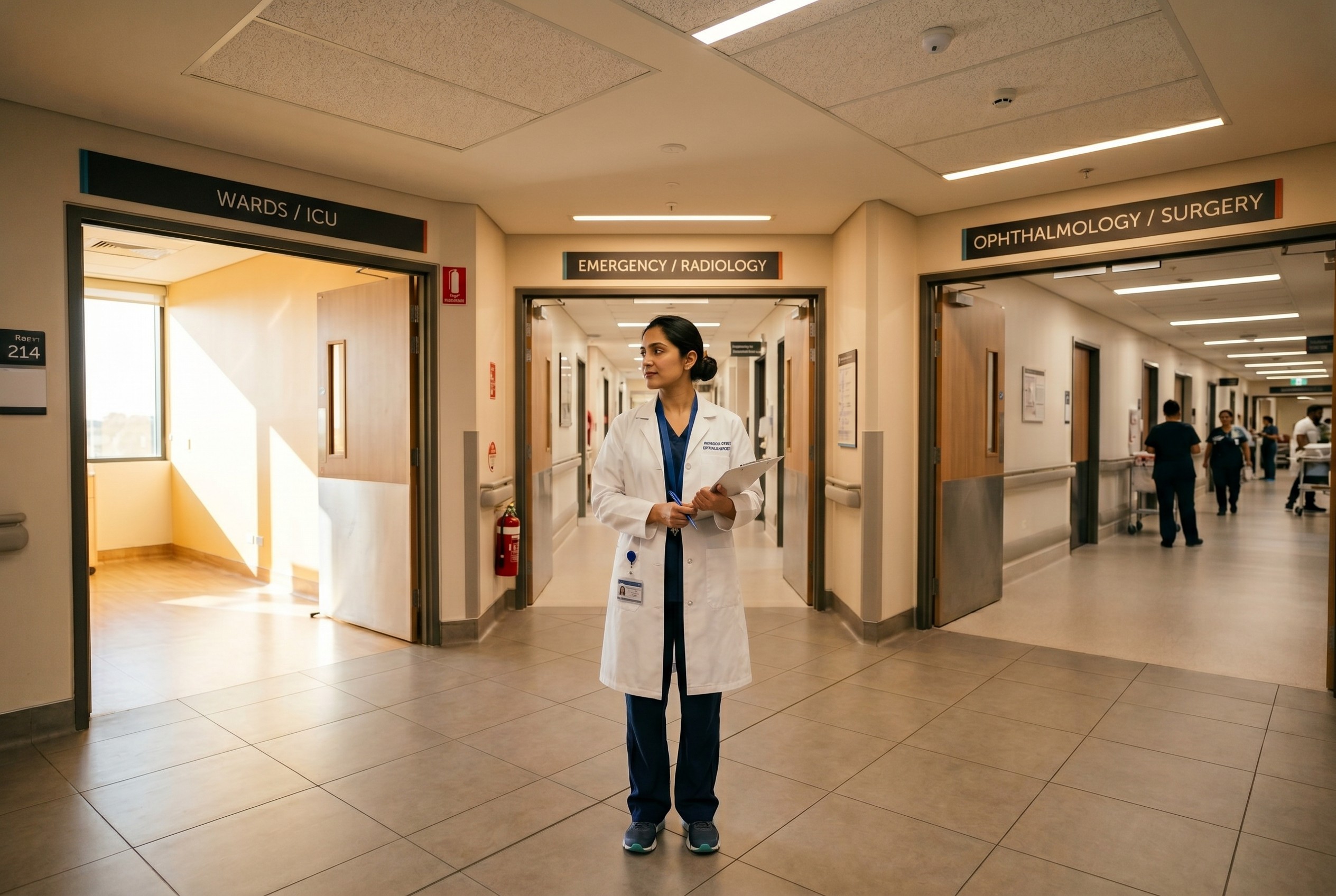
By the time an ophthalmology resident hits the final year of training, the decision window is already closing. Recruiters have been reaching out since the end of PGY-2. The hospital employment offers come in structured and polished, the PE groups come in with signing bonuses and retention equity, and somewhere in the back of the room an academic department chair is offering a junior faculty slot with a pathway to something vague.
Three options get presented as the full menu. Hospital salary, PE contract, or academic appointment. The 4th option, the one where a trained ophthalmologist actually owns the practice they walk into, barely gets mentioned in any training program in the country. Most residents finish fellowship having never heard the word "MSO" used in a real sentence, and that omission represents a 20-year gap in how the profession talks to its own successors.
What Each Path Actually Looks Like for an Ophthalmologist at Year 1, 5, 10, and 20
AAMC data for the Class of 2024 put the average education debt among indebted medical school graduates at $212,341. A PGY-1 stipend ran about $65,100 in 2024. A 3-year ophthalmology residency plus a 1 or 2-year fellowship puts a new attending on the job market somewhere between age 31 and 33, carrying debt that's been accruing interest for almost a decade.
At year 1, the hospital employment path starts strongest on paper. A base salary in the $380,000 range, benefits, malpractice covered, no overhead to manage. A PE-backed group comes in higher, with Physician Side Gigs data putting the PE-backed ophthalmology average at about $692,000 once RVU production stabilizes. Academic medicine runs closer to $384,000. The ownership path at year 1 looks like the worst of the four, with a new successor pulling a physician salary out of a practice while the business transitions and stabilizes.
By year 5, the picture starts to invert. The hospital employee is still making roughly what they made at year 1 with modest increases, because hospital comp is capped by the structure. The PE employee is deep into RVU quotas and starting to understand what a repayment event actually means when the platform sells. The academic physician is promoted through assistant to associate professor. The owner, working inside a practice running $2M in collections at the benchmark 60% overhead ratio, is taking home somewhere around $800,000 and holding equity in a business that compounds every year they stay.
By year 10, the owner is typically the highest earner by a wide margin, with the additional benefit that nobody is setting their schedule, managing their clinical decisions, or restructuring their comp formula. By year 20, the gap is generational. The owner has built something that can either be sold, transitioned to a partner, or held as cash flow for retirement. The employees, regardless of which flavor of employment they chose, have a W-2 history.
Why Ophthalmologists Don't Hear About the 4th Option in Training
The structural reason is that ownership requires a bridge, and until recently that bridge didn't exist for most trainees. Buying a practice at age 32 with $212,000 in student debt, no savings, and no operational experience is a nonstarter for 95% of physicians. A personal guarantee on a seven-figure SBA loan on top of training debt is the kind of risk most finance-literate adults would advise against.
What changed is the MSO structure. In a physician-led MSO acquisition, the management company acquires the non-clinical assets, a successor physician takes ownership of the professional corporation with zero dollars down, and the retiring physician stays on to hand off patients and clinical protocols. The successor builds equity in an established practice without signing a personal guarantee. The economics work because the retiring physician needs a successor and there aren't enough young ophthalmologists willing to buy out of pocket.
The Health Affairs 2024 study covering 200 PE-acquired ophthalmology practices found a 265% increase in physician turnover after acquisition, with physicians under 40 leaving at 2.28 times the replacement rate. That rate reflects an environment problem more than a hiring problem, because the same physicians leaving PE are the physicians who would have been ideal ownership candidates if anyone had told them the option existed.
How to Think About the Ophthalmology Decision Window Before Fellowship Ends
The fellowship year is the single best time to evaluate the full menu because the pressure is real but the commitment is still theoretical. Most recruiters expect a decision between December and February of the final year. Any evaluation that happens after May is happening under duress.
A useful framework: write down what the year 10 version of each path actually looks like, focusing on the compensation curve across a decade rather than the compensation at year 1. Hospital employment typically plateaus at year 5. PE contracts have retention equity tied to hold periods of 5 to 7 years, and the realization of that equity depends heavily on deal structure, bad leaver clauses, and whether the platform's secondary sale actually delivers the returns the sponsors underwrote. Academic medicine runs its own compensation ladder that's predictable and modest. Ownership runs a different curve entirely, because the person building the equity is also the person working inside the asset.
Every ophthalmologist finishing training has about 90 days where they can genuinely evaluate all four. After that, the recruiters have narrowed the choice.
The One Question Worth Asking Every Recruiter During Ophthalmology Fellowship
What does year 10 look like for a physician who signed this contract in year 1? Most employment-track recruiters will give a vague answer because there isn't a good one. The physician who signs a PE contract in year 1 rolls equity into a platform that sells in year 5, re-rolls into the next platform, and spends year 10 wondering why the compensation formula keeps changing. The hospital employee spends year 10 renegotiating the same contract they signed in year 1. The owner, assuming the practice was structured well, spends year 10 running the business they built.
The answer to that one question reveals the shape of the 20-year path faster than any compensation table will. Most residents finish training having never been asked to think that far out, which is exactly why the decision window closes before they've genuinely opened it.
Educational material only. Figures are illustrative and individual results vary. Images are AI-generated illustrations and do not depict actual Verdira practices, physicians, or patients. See our Disclosures.

Written by
Verdira Team
Verdira is building a permanent home for ophthalmology practices. We write about succession, physician ownership, and the forces reshaping eye care in the United States.
In This Article
Share
Ready to secure your legacy?
We're here to ensure your hard work is valued and your business thrives as part of Verdira.
Disclosures
The content of this site is for general informational purposes only and is not intended to constitute an offer to sell or a solicitation to buy any security or other asset, or a promise to undertake or solicit business, and may not be relied upon in connection with any offer or sale of securities or other assets.
The content of this site is for general informational purposes only and is not intended to constitute an offer to sell or a solicitation to buy any security or other asset, or a promise to undertake or solicit business, and may not be relied upon in connection with any offer or sale of securities or other assets.
The content of this site is for general informational purposes only and is not intended to constitute an offer to sell or a solicitation to buy any security or other asset, or a promise to undertake or solicit business, and may not be relied upon in connection with any offer or sale of securities or other assets.
© 2026 Verdira Management NY, LLC