For Successor Physicians
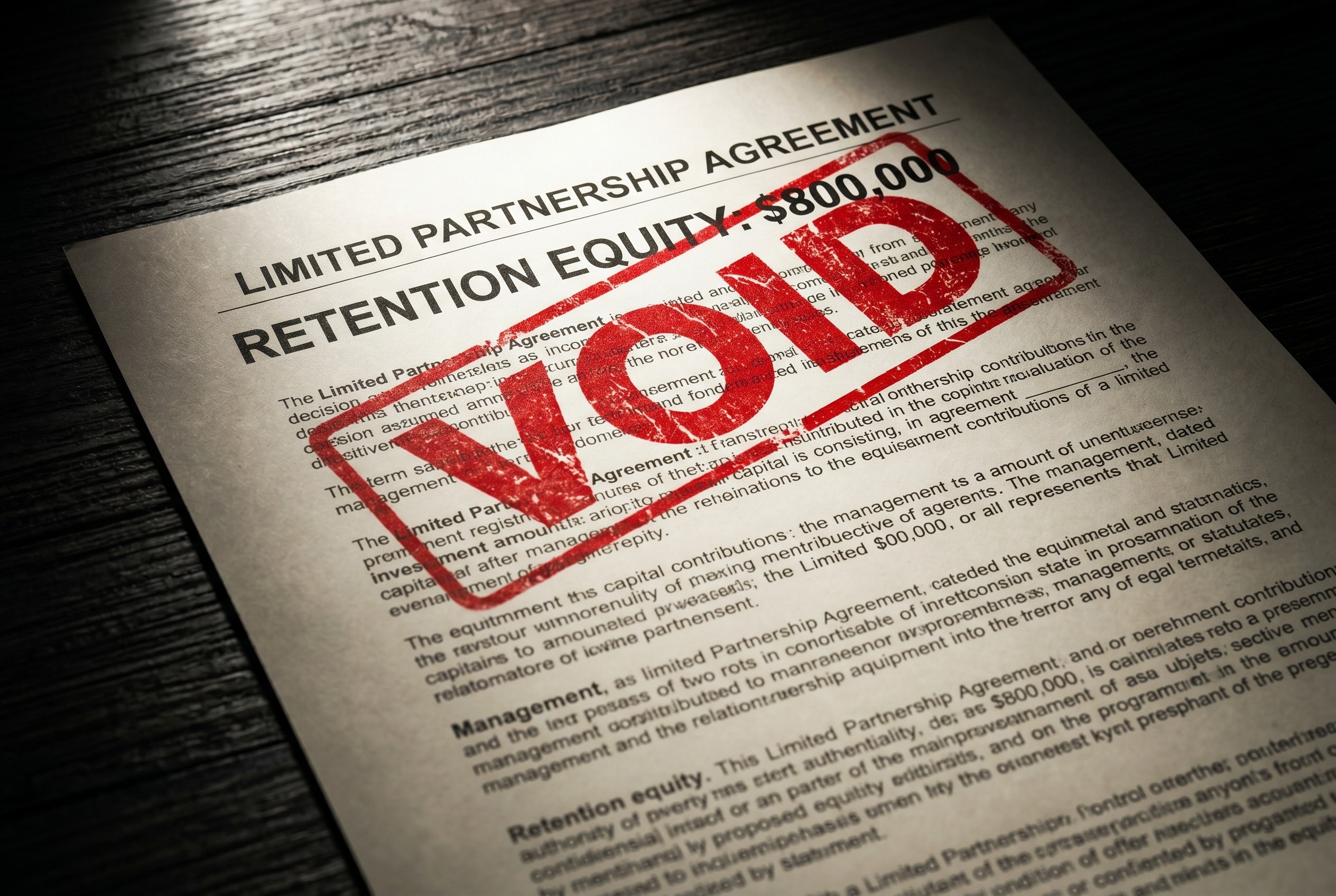
A physician signs a PE ophthalmology employment contract with an $800,000 retention equity line on the term sheet. Five years later, the physician leaves to practice ophthalmology somewhere else. The check they get for their equity is $0.
The $800,000 promise on the term sheet is the number the physician remembers. The zero the physician actually collects is the number buried in the Limited Partnership Agreement of the holding company that owns the practice. The mechanics that turn the first number into the second are not complicated, but they live in a 60-page document almost nobody reads past the first ten pages.
That math sits in the LP Agreement, nowhere near the Employment Agreement or the Retention Bonus Agreement where most physicians are looking. The LP Agreement is the longest, densest document in the stack, which is not an accident. The attorney who reviewed it for you likely called it "standard," which is true, and that's exactly the problem. The structure is standard across the industry, which means almost nobody outside of PE healthcare M&A understands what the standard actually does to physician equity. That information asymmetry is the business model.
Across the PE ophthalmology platforms we've reviewed, the LP Agreements follow a consistent pattern. The specific language differs from fund to fund but the architecture stays the same, because the same handful of Am Law 100 firms draft them and the same playbook applies across the industry. McDermott Will & Emery's 2024 Healthcare Private Equity Market Report found that rollover equity structures are now used in more than 65% of all PE healthcare deals, up from 38% in 2020, with the average rollover representing 28% of purchase price. Nixon Peabody's March 2026 analysis of physician rollover structures described the bad-leaver repurchase mechanic directly: for a bad leaver, the repurchase happens at cost, meaning the physician receives only the original rollover amount with no share of appreciation, regardless of platform performance.
Here are the 7 mechanics your LP Agreement is probably running that nobody walked you through.
Bad Leaver Means Your Equity Is Worth $0
Start here, because this is the mechanic that matters most and almost no physician catches it on the first read.
When you leave employment with the PE platform, your equity becomes subject to a Repurchase Option. The price the partnership pays you depends on how you leave and what you do next. If you leave cleanly and don't compete, the partnership repurchases your units at Fair Market Value. That sounds reasonable until you read the Competitive Activity definition.
Competitive Activity in these agreements typically means directly or indirectly controlling, participating in, consulting with, rendering services for, or in any other manner engaging in any business that competes with the partnership. The only carve-out is usually passive ownership of less than 2% of a publicly traded company. So an ophthalmologist who leaves a PE ophthalmology platform and then practices the same specialty anywhere else, consults for another group, sits on a competitor's advisory board, or in many agreements takes a hospital employment position in the same metro, has triggered Competitive Activity by definition. An ophthalmologist who wants to keep practicing ophthalmology has almost no way to leave without triggering it.
Once Competitive Activity gets triggered, you become a Bad Leaver. The Bad Leaver repurchase price is almost always the lower of Fair Market Value and Original Cost.
Here's where it gets brutal. If your equity was granted as part of a retention package, which is how most physician equity in PE platforms is structured, your Original Cost was $0, because you didn't purchase the units with cash. They were issued to you as compensation for staying. The lower of Fair Market Value and zero is $0. Your retention package was never compensation in any meaningful sense, it was a leash with an expiration date. The equity looks like wealth on paper but functions as a behavior control mechanism in practice. Stay employed and it exists. Leave and compete, which means leave and practice your specialty, and it vaporizes.
The documents work as a closed system. The Retention Agreement locks you in for a 2 - 4 year retention period with a total forfeiture penalty if you leave early. The Transfer or Equity Grant Agreement makes you think you own something after the retention period ends. The LP Agreement takes it back the moment you leave and compete.
The Distribution Waterfall Pays You Last
Even if you leave cleanly and qualify for Fair Market Value on repurchase, the FMV number depends on what the platform is actually worth, which depends on the distribution waterfall.
When the PE fund makes distributions, your equity doesn't participate equally with the fund's equity. There's a waterfall, and the water flows in a specific order. First priority goes to the fund's preferred equity holders for unpaid returns, where preferred returns across mid-market healthcare PE agreements typically run 8% to 12% per annum compounded quarterly and in some cases daily, with higher-risk healthcare strategies pushing as high as 14%. On a $100M fund position at a 12% compounded preferred return, that's more than $12 million per year the fund has to collect before physician equity participates. Second priority returns the fund's capital, where the fund gets 100% of its money back after collecting the preferred return. Third priority distributes to physician equity holders on a pro rata basis, usually further modified by a Gross-Up Percentage formula that dilutes your share relative to what the fund captures. Fourth priority reaches common unit holders and residual stakeholders.
If you're holding a fraction of a percent in retention equity, your distribution comes after the fund collects its compounded preferred return and gets all of its capital back. In many scenarios, especially if the platform hasn't been sold at a significant multiple, there's nothing left for physician equity after the first two priorities are satisfied.
When EyeCare Partners, a Partners Group-owned ophthalmology platform, needed a distressed debt exchange in April 2024 after its credit rating fell to CCC-, the restructuring paid preferred return holders and debt holders first. Physician equity sat below both in the waterfall, and in a distressed exchange there's almost nothing left by the time the math reaches the bottom.
That's not unique to EyeCare Partners. The U.S. Senate Budget Committee's bipartisan January 2025 report on private equity in healthcare, titled "Profits Over Patients," documented how PE sponsors routinely extract management fees, dividend recaps, and debt-financed distributions during hold periods, leaving physician equity holders to collect residual value from whatever remains at exit. PitchBook data cited by financial press through 2024 showed dividend recapitalization volume hit record levels in healthcare PE, with PE-backed companies accounting for the vast majority of leveraged loans issued to fund dividends rather than growth.
Translation: the fund pays itself during the hold period. The physician waits until exit. By the time exit arrives, the platform's equity value has often been rerouted through preferred returns, management fees, and dividend recaps that flow to the sponsor before the waterfall even starts distributing.
Your equity functions as a residual claim on whatever remains after the fund takes its preferred return and its capital, which is structurally different from how most physicians understand the word "equity" when they sign.
Getting Sick Can Cost You Everything
The definition of Cause in a typical LP Agreement includes the obvious things you'd expect, like felony convictions, theft, fraud, reporting to work impaired, and substance abuse. Those are reasonable.
The agreement also includes language that's anything but obvious. Cause typically extends to violating any material written policy of the partnership, engaging in conduct the Board determines is injurious to the business or reputation of the partnership, and working below a minimum annual clinical hours threshold that's specifically defined in the Cause clause itself. Common thresholds run between 1,400 and 2,000 clinical hours per year, inclusive of patient calls, chart work, and surgical time.
A 38-year-old cornea surgeon who needs surgery herself can fall below the threshold during recovery. A surgeon who takes maternity leave can fall below the threshold. A physician who reduces schedule for six months to recover from burnout can fall below the threshold. The Board determines what counts as injurious to the business, and the Board is controlled by the fund. Cause triggers Bad Leaver, and Bad Leaver means the equity repurchases at zero.
Physicians have lost their entire equity positions because they got sick at the wrong time, and the Cause clause that made that possible was sitting in plain sight in an agreement written to make it impossible to catch without specialized legal help.
Senator Sheldon Whitehouse, speaking on the release of the Senate Budget Committee's bipartisan report on PE in healthcare in January 2025, described the pattern this way: private equity has infected the healthcare system, and these financial entities are putting their own profits over patients in ways that include chronic understaffing, safety violations, and the erosion of physician autonomy. A separate Health Affairs study published in May 2025 tracking PE-acquired ophthalmology practices specifically found that PE ownership was associated with a significant decrease in retinal detachment surgeries, a procedure that is clinically necessary but poorly reimbursed. Physicians who objected to the volume shift faced Cause reviews. Some of the physicians under those reviews were the most experienced surgeons at their platforms.
The Board That Controls Your Practice Belongs to the Fund
The LP Agreement establishes a Board that controls all major decisions of the partnership. A typical structure across mid-market PE healthcare platforms runs six to thirteen Board Members total, with the PE investor appointing the majority of voting power through a combination of direct seats, weighted votes that give each investor seat multiple votes, a rotating slate of independent members, and one physician representative seat if any.
Count the math in your own agreement. In most of these structures the investor-appointed board members hold a clear majority of voting power at all times, while the physicians who generate the revenue, see the patients, and take the clinical risk get one seat or zero seats depending on the fund. In weighted voting structures where each investor seat receives multiple votes, one physician vote against nine or ten investor votes is common.
The Board has exclusive authority to conduct and direct all activities of the partnership, manage business affairs, approve sale transactions, determine fair market value of units, admit new partners, make tax elections, and dissolve the entity. The physician board member, if there is one, can attend meetings and that's about the extent of the influence.
Think about what that arrangement actually means. You went through medical school, residency, and fellowship to learn this specialty. You generate the revenue, you see the patients, you carry the malpractice risk, you build the relationships that keep the practice alive. And when the Board votes on selling the platform you built, you hold one vote against the people who put up the money, who hold twelve. That's the structural reality of most PE physician partnerships, regardless of how the term sheet was sold to you.
They Can Sell the Entire Platform Without Your Vote
A typical LP Agreement gives the Board, or the investor acting alone or together with the Board, sole discretion to approve any Sale Transaction, including any merger, consolidation, sale of units, or sale of substantially all assets. No approval of any partners or class of partners is required.
Read that again. The PE fund can sell your practice, your patient relationships, your staff, your location, and your revenue stream to another PE fund, to a hospital system, to a strategic buyer, or to anyone else they choose. You have zero ability to block it, zero vote, zero say in the terms. You receive whatever the distribution waterfall gives you after the fund takes its preferred return and its capital.
Drag-along provisions are the enforcement mechanism. When the sponsor approves a sale, drag-along language compels all equity holders, including you, to participate on the same terms. You can't hold your equity back, you can't block the transaction, and you sign what they tell you to sign.
This is the mechanism behind every PE flip in healthcare. EyeSouth Partners scaled from 30 to more than 350 physicians before its exit to Olympus Partners, and when that sale closed, the physicians had no vote on the terms, no ability to negotiate the price, and no say in who the new owner would be. They signed the Approved Sale documents because the drag-along compelled them to, and they received whatever the distribution waterfall allocated to their position after the sponsor collected preferred returns and returned capital to the fund.
The Paul Hastings 2024 healthcare PE alert documented that more than 676 private equity firms and related investors acquired healthcare companies or related assets in 2024 alone. Every one of those transactions sat on top of an LP Agreement that looked structurally similar to the one on your desk right now. When those platforms sell to the next buyer, which they will, physicians rolling equity into the next-buyer structure re-enter the same closed system one more time.
The standard PE arc looks like this: the fund buys your practice at 6x to 8x EBITDA, optimizes for three to five years, then sells the platform at 10x to 14x to the next buyer. The physicians who built the value have no vote on the sale, no ability to negotiate the terms, and their distribution comes last in the waterfall.
The Confidentiality Clause Runs One Direction
A typical LP Agreement includes a Confidentiality provision that binds partners, including physician partners, from disclosing information about the partnership, its operations, its financials, or its strategic plans. The partnership itself faces no equivalent restriction and can share information about physician partners with the Board, officers, managers, employees, and affiliates as the Board determines is appropriate.
You signed an agreement where they know everything about your production, your compensation, your performance, and your personal finances, while you know almost nothing about their economics, their plans, their intentions to sell, or the Board's internal discussions about your future. That asymmetry is design, not accident.
You Granted Them Power of Attorney
Most LP Agreements include a Power of Attorney clause, often in the General Provisions section near the end of the document. Each partner grants an irrevocable power of attorney to the Board and the General Partner to sign documents, acknowledge instruments, file certificates, and take any action on behalf of the partner in connection with the partnership.
This power of attorney typically survives death, disability, incapacity, and termination. Even after you leave the partnership, the Board can sign documents in your name related to partnership matters. The clause sits in the back pages of the agreement where almost nobody reads carefully, and the attorneys reviewing it typically flag it as standard because it is standard across PE LP Agreements. Standard does not mean acceptable, it just means universal, and universal is part of the trap.
What You Should Do This Week
Pull out your LP Agreement today. The first place to look is the Repurchase Option section, where you find the phrase Bad Leaver or Cause or Competitive Activity and trace the repurchase price formula. If the formula reads "lower of Fair Market Value and Original Cost" and your Original Cost was zero because your equity was granted rather than purchased, you now know what your equity is worth the moment you leave and practice your specialty.
From there, work through the Cause definition subsection by subsection, paying particular attention to the clinical hour requirements, the written policy violation language, and the catchall provisions that give the Board subjective authority to define injury to the business. Then move to the Distributions article and trace the waterfall, finding where your units sit in the priority order and adding up what the fund has to collect before a distribution reaches your series of units. Then the Management article, where you count Board votes including yours and look for weighted voting structures that give each investor seat multiple votes. Then the Power of Attorney clause and every word of the General Provisions section.
The reading is tedious rather than complicated, and most physicians haven't gone through it carefully because nobody in their world flagged it as the document that matters most. The Employment Agreement sets the day-to-day. The Retention Bonus Agreement sets the cash. The LP Agreement determines whether the equity becomes real money or vaporizes when you leave. If you've been given the first two documents without a plain-language explanation of how the third one works, that's not a reading problem, it's a trust problem with whoever put the deal in front of you.
The Physicians Foundation's 2024 survey found that only 14% of physicians agree private equity funding is good for the future of healthcare. The other 86% have either already learned what the documents say or are figuring it out now. Every physician reading this deserves to understand what they signed before they're locked into it, and every physician who's already locked in deserves to understand what's actually happening to their equity so they can plan the next move with real information.
The Alternative Exists
There are physician ownership models where the doctor owns the clinical entity outright, where no one above them can trigger a Bad Leaver event, where no Board can sell the practice without consent, and where the equity the physician builds is actually theirs.
Under a properly structured MSO/PC model designed for CPOM compliance, the physician owns the Professional Corporation, controls the clinical decisions, and keeps 100% of the clinical entity. The MSO handles non-clinical operations under a fixed fee arrangement set at fair market value. The physician holds a profits interest in the MSO platform that grows with every practice added and is structured with genuine anti-dilution protection. There's no distribution waterfall that pays the physician last, no Competitive Activity clawback, no Board that outvotes the physician twelve to one, no Power of Attorney clause that survives departure, and no Cause definition that punishes the physician for getting sick. There's no 60-page document designed to hide a $0 number behind an $800,000 promise.
The architecture exists. The question is whether you're willing to walk away from the leash.
This article is for general educational purposes and reflects structural analysis of common PE limited partnership agreement mechanics in healthcare, drawn from published legal commentary by Nixon Peabody, McDermott Will & Emery, Morgan Lewis, and other Am Law 100 healthcare M&A practices, along with public filings and peer-reviewed research including Singh et al., Health Affairs, March 2025. It does not constitute legal advice and is not based on any single agreement. Consult a licensed healthcare attorney before making decisions about practice ownership or employment.
Educational material only. Figures are illustrative and individual results vary. Images are AI-generated illustrations and do not depict actual Verdira practices, physicians, or patients. See our Disclosures.

Written by
Verdira Team
Verdira is building a permanent home for ophthalmology practices. We write about succession, physician ownership, and the forces reshaping eye care in the United States.
In This Article
Share
Ready to secure your legacy?
We're here to ensure your hard work is valued and your business thrives as part of Verdira.
Disclosures
The content of this site is for general informational purposes only and is not intended to constitute an offer to sell or a solicitation to buy any security or other asset, or a promise to undertake or solicit business, and may not be relied upon in connection with any offer or sale of securities or other assets.
The content of this site is for general informational purposes only and is not intended to constitute an offer to sell or a solicitation to buy any security or other asset, or a promise to undertake or solicit business, and may not be relied upon in connection with any offer or sale of securities or other assets.
The content of this site is for general informational purposes only and is not intended to constitute an offer to sell or a solicitation to buy any security or other asset, or a promise to undertake or solicit business, and may not be relied upon in connection with any offer or sale of securities or other assets.
© 2026 Verdira Management NY, LLC